Activity 3.2 – Movement Translation
How to Bring Words to Life!
:root {
–sage: #7A9E7E;
–sage-light: #EAF2EB;
–gold: #C8A951;
–gold-light: #FDF6E3;
–pink: #E8A598;
–pink-light: #FDECEA;
–teal: #4A8FA8;
–teal-light: #E6F3F7;
–charcoal: #3A3A3A;
–mid: #6B6B6B;
–white: #FFFFFF;
–off-white: #FAFAF8;
}
* { box-sizing: border-box; margin: 0; padding: 0; }
body {
font-family: ‘DM Sans’, sans-serif;
background: var(–off-white);
color: var(–charcoal);
line-height: 1.7;
}
/* ── Header ── */
header {
background: linear-gradient(135deg, var(–sage) 0%, #5d8562 100%);
color: white;
text-align: center;
padding: 28px 24px 24px;
position: relative;
overflow: hidden;
}
header::before {
content: ”;
position: absolute;
top: -50px; right: -50px;
width: 220px; height: 220px;
background: rgba(255,255,255,0.07);
border-radius: 50%;
}
header::after {
content: ”;
position: absolute;
bottom: -70px; left: -40px;
width: 180px; height: 180px;
background: rgba(255,255,255,0.05);
border-radius: 50%;
}
.wordmark {
font-size: 10px;
font-weight: 600;
letter-spacing: 3.5px;
text-transform: uppercase;
opacity: 0.8;
margin-bottom: 6px;
display: inline-block;
background: rgba(255,255,255,0.18);
border: 1px solid rgba(255,255,255,0.35);
border-radius: 20px;
padding: 4px 16px;
font-size: 11px;
font-weight: 600;
letter-spacing: 1px;
text-transform: uppercase;
margin-bottom: 8px;
}
header h1 {
font-family: ‘Playfair Display’, serif;
font-size: clamp(26px, 5vw, 40px);
font-weight: 700;
line-height: 1.2;
margin-bottom: 8px;
}
header .header-icon {
font-size: 28px;
margin-bottom: 6px;
display: block;
}
header p.tagline {
font-size: 15px;
opacity: 0.92;
max-width: 460px;
margin: 0 auto;
font-style: italic;
}
/* ── Main ── */
main { max-width: 820px; margin: 0 auto; padding: 44px 24px 64px; }
/* ── Shared section card ── */
.section {
background: var(–white);
border-radius: 16px;
padding: 30px 34px;
margin-bottom: 28px;
box-shadow: 0 2px 14px rgba(0,0,0,0.05);
}
.section-eyebrow {
font-size: 10px;
font-weight: 700;
letter-spacing: 2.5px;
text-transform: uppercase;
margin-bottom: 6px;
}
.section h2 {
font-family: ‘Playfair Display’, serif;
font-size: 21px;
font-weight: 700;
margin-bottom: 14px;
}
.section p {
font-size: 15px;
color: var(–mid);
margin-bottom: 10px;
}
.section p:last-child { margin-bottom: 0; }
/* ── Intro ── */
.intro { border-left: 5px solid var(–sage); }
.intro .section-eyebrow { color: var(–sage); }
/* ── How to Use ── */
.howto { border-left: 5px solid var(–teal); }
.howto .section-eyebrow { color: var(–teal); }
.steps { list-style: none; margin-top: 4px; }
.steps li {
display: flex;
gap: 14px;
align-items: flex-start;
margin-bottom: 12px;
}
.step-dot {
min-width: 26px; height: 26px;
background: var(–teal);
color: white;
border-radius: 50%;
display: flex; align-items: center; justify-content: center;
font-size: 13px;
flex-shrink: 0;
margin-top: 3px;
}
.step-text {
font-size: 14.5px;
color: var(–mid);
line-height: 1.65;
}
.step-text strong { color: var(–charcoal); }
.step-text em {
display: block;
font-style: italic;
color: var(–teal);
margin-top: 3px;
font-size: 14px;
}
/* ── Table section ── */
.table-section { border-left: 5px solid var(–gold); }
.table-section .section-eyebrow { color: var(–gold); }
.movement-table {
width: 100%;
border-collapse: collapse;
margin-top: 10px;
font-size: 14px;
}
.movement-table thead tr {
background: var(–gold);
}
.movement-table thead th {
color: white;
font-weight: 700;
font-size: 12px;
letter-spacing: 0.5px;
text-align: left;
padding: 11px 14px;
}
.movement-table tbody tr {
border-bottom: 1px solid #f0ead8;
transition: background 0.15s;
}
.movement-table tbody tr:nth-child(odd) { background: var(–white); }
.movement-table tbody tr:nth-child(even) { background: var(–gold-light); }
.movement-table tbody tr:hover { background: #fdf0c8; }
.movement-table td { padding: 11px 14px; color: var(–charcoal); vertical-align: middle; }
.verb-cell {
font-family: ‘Playfair Display’, serif;
font-size: 15px;
font-weight: 700;
color: var(–charcoal);
white-space: nowrap;
}
.movement-cell { color: var(–mid); }
.sound-cell {
font-style: italic;
color: var(–gold);
font-weight: 500;
white-space: nowrap;
}
/* ── Try This ── */
.trythis { border-left: 5px solid var(–pink); }
.trythis .section-eyebrow { color: var(–pink); }
.question-cards {
display: flex;
gap: 14px;
flex-wrap: wrap;
margin: 16px 0;
}
.question-card {
flex: 1;
min-width: 200px;
background: var(–pink-light);
border-radius: 12px;
padding: 16px 18px;
}
.q-label {
font-size: 10px;
font-weight: 700;
letter-spacing: 1.5px;
text-transform: uppercase;
color: var(–pink);
margin-bottom: 6px;
}
.q-text {
font-family: ‘Playfair Display’, serif;
font-style: italic;
font-size: 14.5px;
color: var(–charcoal);
line-height: 1.5;
}
.bridge-line {
background: var(–sage-light);
border-radius: 10px;
padding: 14px 18px;
font-size: 14.5px;
color: var(–mid);
line-height: 1.65;
margin-top: 4px;
}
.bridge-line strong { color: var(–charcoal); }
/* ── Footer ── */
footer {
text-align: center;
padding: 24px;
font-size: 12px;
color: var(–mid);
border-top: 1px solid #e6e6e6;
}
footer a { color: var(–sage); text-decoration: none; }
@media (max-width: 560px) {
.section { padding: 22px 18px; }
.movement-table thead th, .movement-table td { padding: 9px 10px; }
}
🏃
Movement Translation
Bring verbs to life through action!
Why This Works
When the Body Reads the Word
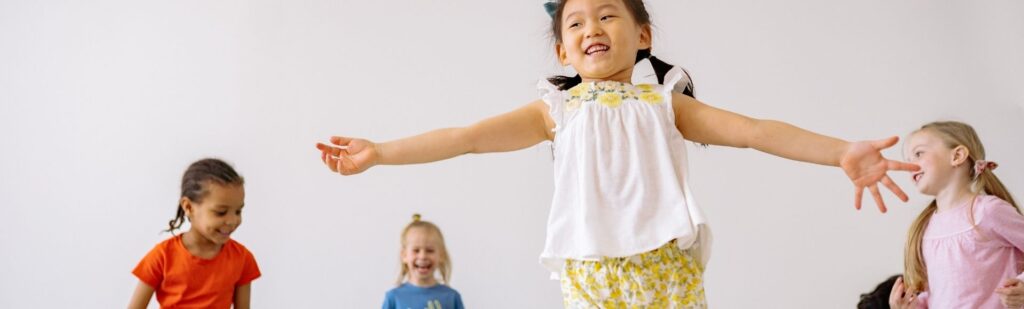
This activity helps children translate action words into movement, connecting language, imagination, and the body. When kids move as they read, they don’t just hear words — they feel them. This builds comprehension, vocabulary, and focus — especially for wiggly readers!
Verbs are the engine of every story. They carry the energy, the emotion, and the momentum. By giving those words a physical home in the body, children remember them more deeply and understand them more fully. A word like creep means something different once you’ve felt your own feet slow and your breath hush.
This isn’t about being a good dancer or a good actor — it’s about play. And play is always the best teacher.
Getting Started
How to Use This Activity
-
1
Pick one or two action words (verbs) from your story. Don’t try to act out every word — one or two per session is plenty. -
2
Invite your child to act them out together.
“Let’s show what that word looks like!” -
3
Add a sound effect or facial expression if you like. It makes the word even more memorable — and brings in extra giggles. -
4
Celebrate effort, not accuracy. The goal is joyful connection, not choreography!
Reference Guide
Movement Translation Table
Use these as starting points — your child’s version is always the right version.
| Verb | Possible Movements | Add Sound? |
|---|---|---|
| Jump | Small hops in place | “Boing!” |
| Tiptoe | Soft, slow steps on the balls of your feet | “Shh…” |
| Fly | Sweep arms wide like wings | Wind whoosh |
| Roar | Lean body forward, arms out wide | “ROAR!” |
| Stomp | Heavy, deliberate steps | “Thud! Thud!” |
| Stretch | Reach arms as high as possible | Big slow exhale |
| Gallop | Alternating high knees, rhythmic | “Clip-clop!” |
| Creep | Slow crawl or sliding steps, hunched | “Ssss…” |
| Spin | Turn slowly with arms out | Laugh or “Whee!” |
| Wave | Slow, flowing swirl of one arm | “Whoosh!” |
Reflect Together
Try This After Your Read
After acting out a movement, pause and ask your child one of these questions. You don’t need both — one is plenty.
Ask
“How did that movement feel?”
Or Ask
“Can you think of another way to show that action?”
Each movement builds a bridge between body and word — turning stories into sensory adventures, and language into something your child carries in their hands, their feet, and their memory.
Please click here to download the Activity – How to Bring Words to Life

:root {
–sage: #7A9E7E;
–sage-light: #EAF2EB;
–gold: #C8A951;
–gold-light: #FDF6E3;
–pink: #E8A598;
–pink-light: #FDECEA;
–teal: #4A8FA8;
–teal-light: #E6F3F7;
–charcoal: #3A3A3A;
–mid: #6B6B6B;
–white: #FFFFFF;
–off-white: #FAFAF8;
}
* { box-sizing: border-box; margin: 0; padding: 0; }
body {
font-family: ‘DM Sans’, sans-serif;
background: var(–off-white);
color: var(–charcoal);
line-height: 1.7;
}
/* ── Header ── */
header {
background: linear-gradient(135deg, var(–sage) 0%, #5d8562 100%);
color: white;
text-align: center;
padding: 52px 24px 42px;
position: relative;
overflow: hidden;
}
header::before {
content: ”;
position: absolute;
top: -50px; right: -50px;
width: 220px; height: 220px;
background: rgba(255,255,255,0.07);
border-radius: 50%;
}
header::after {
content: ”;
position: absolute;
bottom: -70px; left: -40px;
width: 180px; height: 180px;
background: rgba(255,255,255,0.05);
border-radius: 50%;
}
.wordmark {
font-size: 10px;
font-weight: 600;
letter-spacing: 3.5px;
text-transform: uppercase;
opacity: 0.8;
margin-bottom: 10px;
}
.activity-badge {
display: inline-block;
background: rgba(255,255,255,0.18);
border: 1px solid rgba(255,255,255,0.35);
border-radius: 20px;
padding: 4px 16px;
font-size: 11px;
font-weight: 600;
letter-spacing: 1px;
text-transform: uppercase;
margin-bottom: 14px;
}
header h1 {
font-family: ‘Playfair Display’, serif;
font-size: clamp(26px, 5vw, 40px);
font-weight: 700;
line-height: 1.2;
margin-bottom: 12px;
}
header .header-icon {
font-size: 44px;
margin-bottom: 10px;
display: block;
}
header p.tagline {
font-size: 15px;
opacity: 0.92;
max-width: 460px;
margin: 0 auto;
font-style: italic;
}
/* ── Main ── */
main { max-width: 820px; margin: 0 auto; padding: 44px 24px 64px; }
/* ── Shared section card ── */
.section {
background: var(–white);
border-radius: 16px;
padding: 30px 34px;
margin-bottom: 28px;
box-shadow: 0 2px 14px rgba(0,0,0,0.05);
}
.section-eyebrow {
font-size: 10px;
font-weight: 700;
letter-spacing: 2.5px;
text-transform: uppercase;
margin-bottom: 6px;
}
.section h2 {
font-family: ‘Playfair Display’, serif;
font-size: 21px;
font-weight: 700;
margin-bottom: 14px;
}
.section p {
font-size: 15px;
color: var(–mid);
margin-bottom: 10px;
}
.section p:last-child { margin-bottom: 0; }
/* ── Intro ── */
.intro { border-left: 5px solid var(–sage); }
.intro .section-eyebrow { color: var(–sage); }
/* ── How to Use ── */
.howto { border-left: 5px solid var(–teal); }
.howto .section-eyebrow { color: var(–teal); }
.steps { list-style: none; margin-top: 4px; }
.steps li {
display: flex;
gap: 14px;
align-items: flex-start;
margin-bottom: 12px;
}
.step-dot {
min-width: 26px; height: 26px;
background: var(–teal);
color: white;
border-radius: 50%;
display: flex; align-items: center; justify-content: center;
font-size: 13px;
flex-shrink: 0;
margin-top: 3px;
}
.step-text {
font-size: 14.5px;
color: var(–mid);
line-height: 1.65;
}
.step-text strong { color: var(–charcoal); }
.step-text em {
display: block;
font-style: italic;
color: var(–teal);
margin-top: 3px;
font-size: 14px;
}
/* ── Table section ── */
.table-section { border-left: 5px solid var(–gold); }
.table-section .section-eyebrow { color: var(–gold); }
.movement-table {
width: 100%;
border-collapse: collapse;
margin-top: 10px;
font-size: 14px;
}
.movement-table thead tr {
background: var(–gold);
}
.movement-table thead th {
color: white;
font-weight: 700;
font-size: 12px;
letter-spacing: 0.5px;
text-align: left;
padding: 11px 14px;
}
.movement-table tbody tr {
border-bottom: 1px solid #f0ead8;
transition: background 0.15s;
}
.movement-table tbody tr:nth-child(odd) { background: var(–white); }
.movement-table tbody tr:nth-child(even) { background: var(–gold-light); }
.movement-table tbody tr:hover { background: #fdf0c8; }
.movement-table td { padding: 11px 14px; color: var(–charcoal); vertical-align: middle; }
.verb-cell {
font-family: ‘Playfair Display’, serif;
font-size: 15px;
font-weight: 700;
color: var(–charcoal);
white-space: nowrap;
}
.movement-cell { color: var(–mid); }
.sound-cell {
font-style: italic;
color: var(–gold);
font-weight: 500;
white-space: nowrap;
}
/* ── Try This ── */
.trythis { border-left: 5px solid var(–pink); }
.trythis .section-eyebrow { color: var(–pink); }
.question-cards {
display: flex;
gap: 14px;
flex-wrap: wrap;
margin: 16px 0;
}
.question-card {
flex: 1;
min-width: 200px;
background: var(–pink-light);
border-radius: 12px;
padding: 16px 18px;
}
.q-label {
font-size: 10px;
font-weight: 700;
letter-spacing: 1.5px;
text-transform: uppercase;
color: var(–pink);
margin-bottom: 6px;
}
.q-text {
font-family: ‘Playfair Display’, serif;
font-style: italic;
font-size: 14.5px;
color: var(–charcoal);
line-height: 1.5;
}
.bridge-line {
background: var(–sage-light);
border-radius: 10px;
padding: 14px 18px;
font-size: 14.5px;
color: var(–mid);
line-height: 1.65;
margin-top: 4px;
}
.bridge-line strong { color: var(–charcoal); }
/* ── Footer ── */
footer {
text-align: center;
padding: 24px;
font-size: 12px;
color: var(–mid);
border-top: 1px solid #e6e6e6;
}
footer a { color: var(–sage); text-decoration: none; }
@media (max-width: 560px) {
.section { padding: 22px 18px; }
.movement-table thead th, .movement-table td { padding: 9px 10px; }
}
Activity 3.2
🏃
Movement Translation
Bring verbs to life through action!
Why This Works
When the Body Reads the Word
This activity helps children translate action words into movement, connecting language, imagination, and the body. When kids move as they read, they don’t just hear words — they feel them. This builds comprehension, vocabulary, and focus — especially for wiggly readers!
Verbs are the engine of every story. They carry the energy, the emotion, and the momentum. By giving those words a physical home in the body, children remember them more deeply and understand them more fully. A word like creep means something different once you’ve felt your own feet slow and your breath hush.
This isn’t about being a good dancer or a good actor — it’s about play. And play is always the best teacher.
Getting Started
How to Use This Activity
-
1
Pick one or two action words (verbs) from your story. Don’t try to act out every word — one or two per session is plenty. -
2
Invite your child to act them out together.
“Let’s show what that word looks like!” -
3
Add a sound effect or facial expression if you like. It makes the word even more memorable — and brings in extra giggles. -
4
Celebrate effort, not accuracy. The goal is joyful connection, not choreography!
Reference Guide
Movement Translation Table
Use these as starting points — your child’s version is always the right version.
| Verb | Possible Movements | Add Sound? |
|---|---|---|
| Jump | Small hops in place | “Boing!” |
| Tiptoe | Soft, slow steps on the balls of your feet | “Shh…” |
| Fly | Sweep arms wide like wings | Wind whoosh |
| Roar | Lean body forward, arms out wide | “ROAR!” |
| Stomp | Heavy, deliberate steps | “Thud! Thud!” |
| Stretch | Reach arms as high as possible | Big slow exhale |
| Gallop | Alternating high knees, rhythmic | “Clip-clop!” |
| Creep | Slow crawl or sliding steps, hunched | “Ssss…” |
| Spin | Turn slowly with arms out | Laugh or “Whee!” |
| Wave | Slow, flowing swirl of one arm | “Whoosh!” |
Reflect Together
Try This After Your Read
After acting out a movement, pause and ask your child one of these questions. You don’t need both — one is plenty.
Ask
“How did that movement feel?”
Or Ask
“Can you think of another way to show that action?”
Each movement builds a bridge between body and word — turning stories into sensory adventures, and language into something your child carries in their hands, their feet, and their memory.
This activity helps children translate action words into movement, connecting language, imagination, and the body. When kids move as they read, they don’t just hear words—they feel them. This builds comprehension, vocabulary, and focus (especially for wiggly readers!).
How to Use
- Pick one or two action words (verbs) from your story.
- Invite your child to act them out together:
“Let’s show what that word looks like!”
- Add a sound effect or facial expression if you like—it makes it even more memorable.
- Celebrate effort, not accuracy. The goal is joyful connection, not choreography!
Movement Translation Table
|
Verb |
Possible Movements |
Add Sound? |
|---|---|---|
| 🦘 Jump | Small hops | “Boing!” |
| 🕵️ Tiptoe | Soft steps | “Shh…” |
| 🕊️ Fly | Arm flaps | Wind whoosh |
| 🦁 Roar | Lean body forward | “ROAR!” |
| 🐘 Stomp | Heavy steps | “Thud! Thud!” |
| 🦢 Stretch | Reach arms up high | Big exhale |
| 🐎 Gallop | Alternating knees | “Clip-clop!” |
| 🐍 Creep | Slow crawl or slide | “Ssss…” |
| 🌀 Spin | Turn slowly | Laugh or “Whee!” |
| 🧙 Wave | Magic swirl motion | “Whoosh!” |
🌟 Try This
Ask your child:
“How did that movement feel?”
“Can you think of another way to show that action?”
Each movement builds a bridge between body and word—turning stories into sensory adventures.