
Module 3, Lesson 3.1
When Help Doesn’t Feel Helpful
⏰ 15 Minutes
Motivati xxxx
When your child struggles with a word, jumping in can feel almost automatic.
You know the word. You want to help. You don’t want them to struggle unnecessarily.
But sometimes the help we offer can land very differently from the way we intend it.
- A prompt can feel like pressure.
- A reminder can feel like correction.
- And repeated help can start to feel like “I’m getting this wrong again.”
This lesson is about noticing that moment — and beginning to see reading support from your child’s side.
Your goal –Recognize when well-intended help starts to feel like pressure, and notice what is happening between you and your child in that moment.
IN THIS LESSON
A quick look at what you’ll discover:
1️⃣ Notice the correction reflex
Recognize the natural urge to jump in, fix, prompt, or explain when your child struggles.
2️⃣ See help from your child’s side
Explore why the support you intend may feel different to a child who is already working hard.
3️⃣ Notice what happens between you
See how one reaction can trigger another — and how a reading moment can quickly become tense.

THE CORRECTION REFLEX
Helping can happen before we even realize we’re doing it.
Picture this:
Your child comes to a word they don’t know.
They hesitate …. and almost before you realize it, you say –
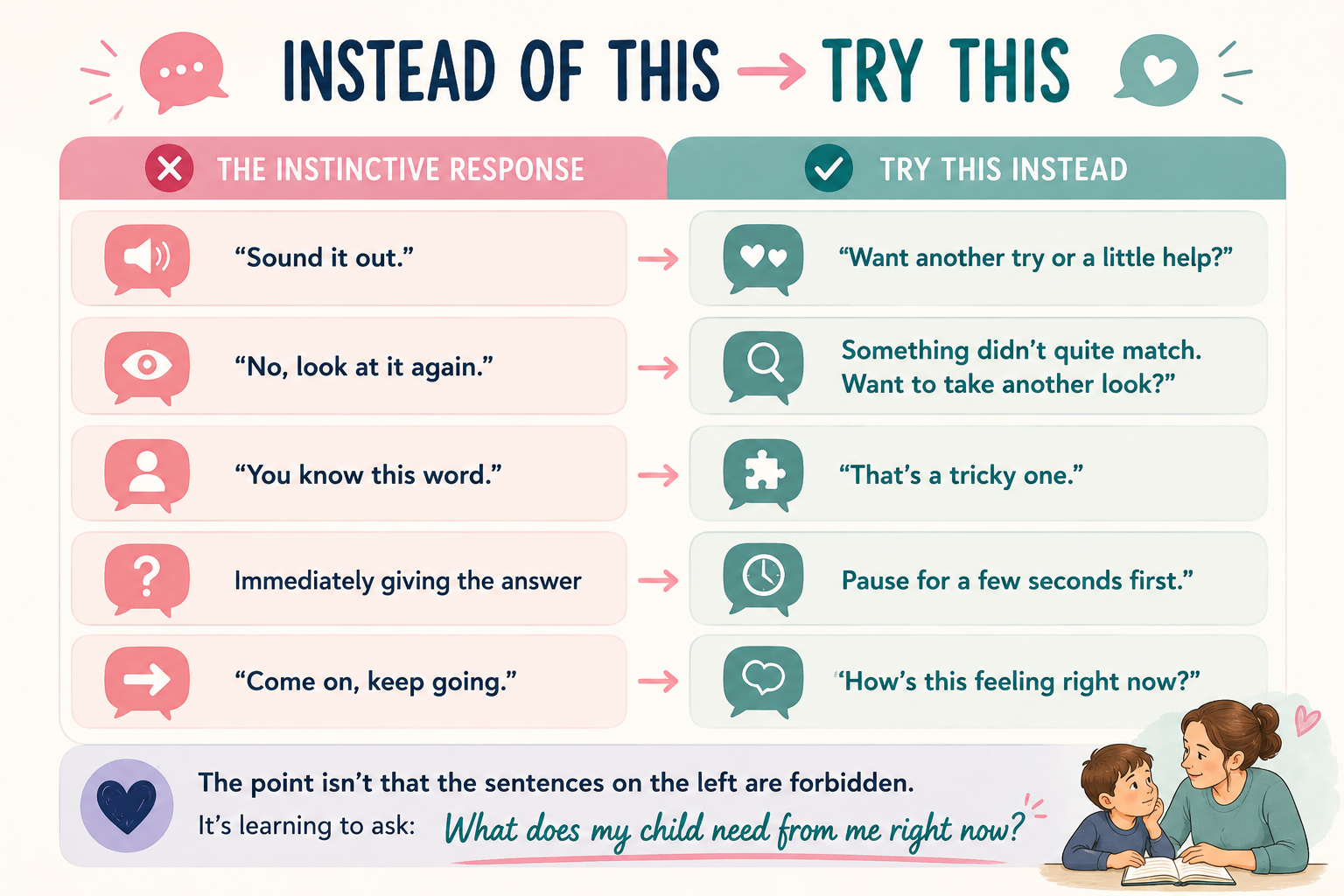
” Sound it out!!”
” Look at the first letter!!”
” You know this word!”
” Try it again!”
” No. that’s not what it says.”
A SMALL SHIFT
None of these comments come from a bad place. Quite the opposite.
We correct because we want to help.
When we can see the answer — or the strategy our child could use — it can be surprisingly hard to sit there and watch them struggle.
Your brain wants to take over the work their brain is trying to do.
That tiny moment is where connection before correction begins.

HELP FROM THE OTHER SIDE
What we intend isn’t always what our child experiences.
Imagine sitting beside your child while they read.
They come to a difficult word. You can see they’re struggling, so you help.

CHILD
“…the enormous elephant…”
They stop at enormous.
PARENT
“Look at the first letter.”
The child tries again.
“E…en…?”
PARENT
“Almost. What sound does that make?”
The child tries again.
“En…or…?”
PARENT
“Remember what we did yesterday?”
WHAT THE PARENT MEANS

“I’m helping.”
I’m giving them clues. I’m showing them what to do. I’m helping them succeed.
WHAT THE CHILD MAY HEAR

“I keep getting it wrong.”
I’m taking too long. I should know this. They’re waiting for me to get this right.
Both Experiences Can Be True
The parent can be patient, loving and genuinely trying to help – and the child can still experience the interaction as pressure.
Intent matters … but impact matters too.
It’s the patterns we’re learning to notice when help becomes:
- frequent
- fast
- layered
A child who is already struggling may begin to experience reading as a string of corrections.
NOTICE THE PATTERN
One prompt may feel like help.
Five prompts in a row can feel like:
“I’m not doing this right.”
WHAT HAPPENS BETWEEN US?
Reading struggles don’t happen in isolation.
Module 2 Asked:
” What’s happening inside me?”
You learned to notice your own worry, frustration, expectations and urge to make things better.
Module 3 Asks:
” What’s happening between us?”
Now we’re paying attention to what happens in the interaction itself.
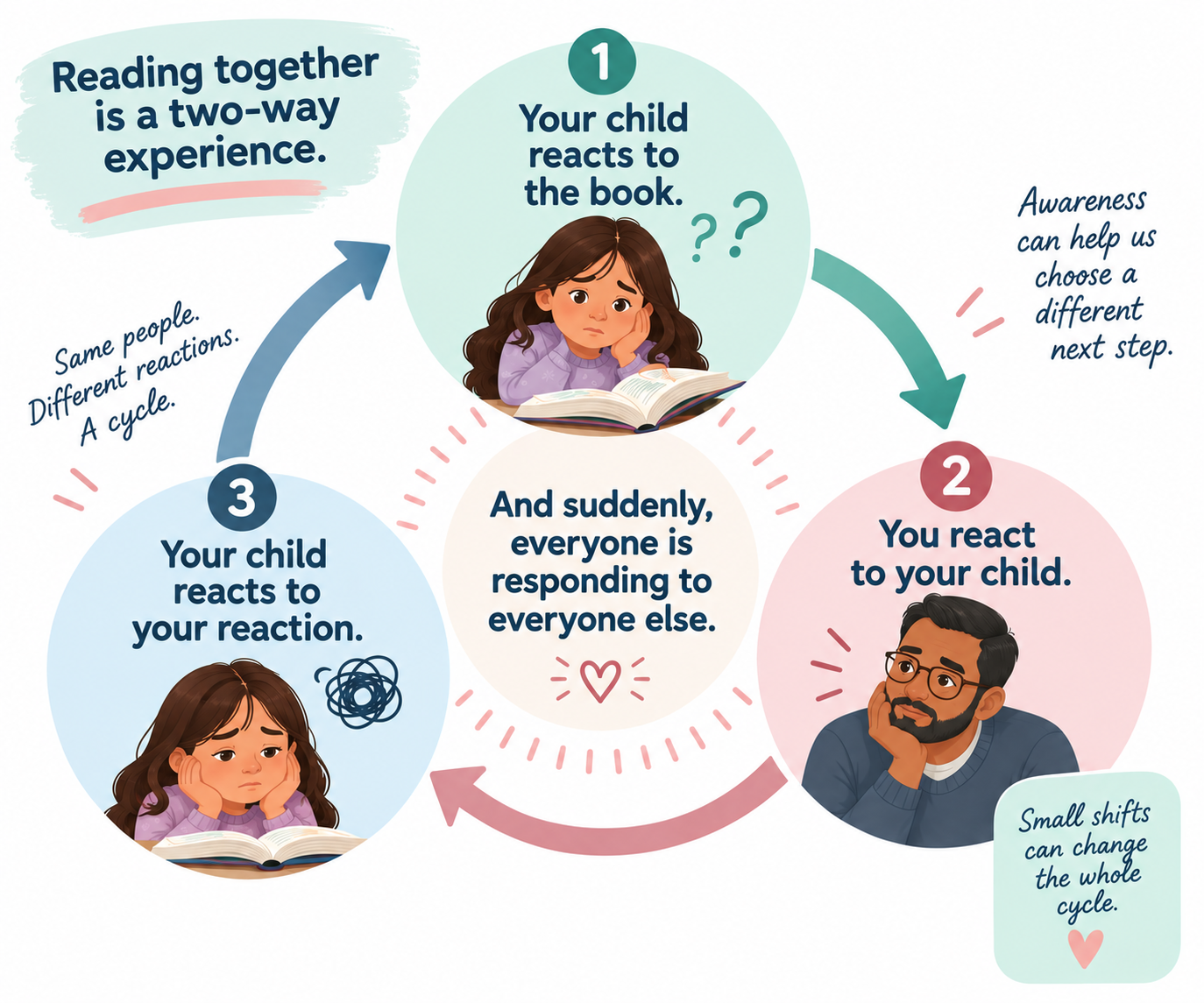
Reading time is a shared experience
Reading together is a two-way experience. Your child’s response to a difficult word, page, or book can shape how you respond—and your response can then shape what happens next for your child. These small reactions can quickly become a cycle, often without either of you realizing it. The good news is that noticing the cycle gives you a chance to change it.
The Correction Cycle
When a child struggles, it’s natural to want to help—and often, that means correcting, prompting, or stepping in quickly. But sometimes that help creates an unintended pattern: the child struggles, we jump in, they feel pressure and pull back, so we help even more. Before long, everyone is working harder, but reading feels harder too. This is the Correction Cycle, and simply noticing when it begins gives us a chance to interrupt it. 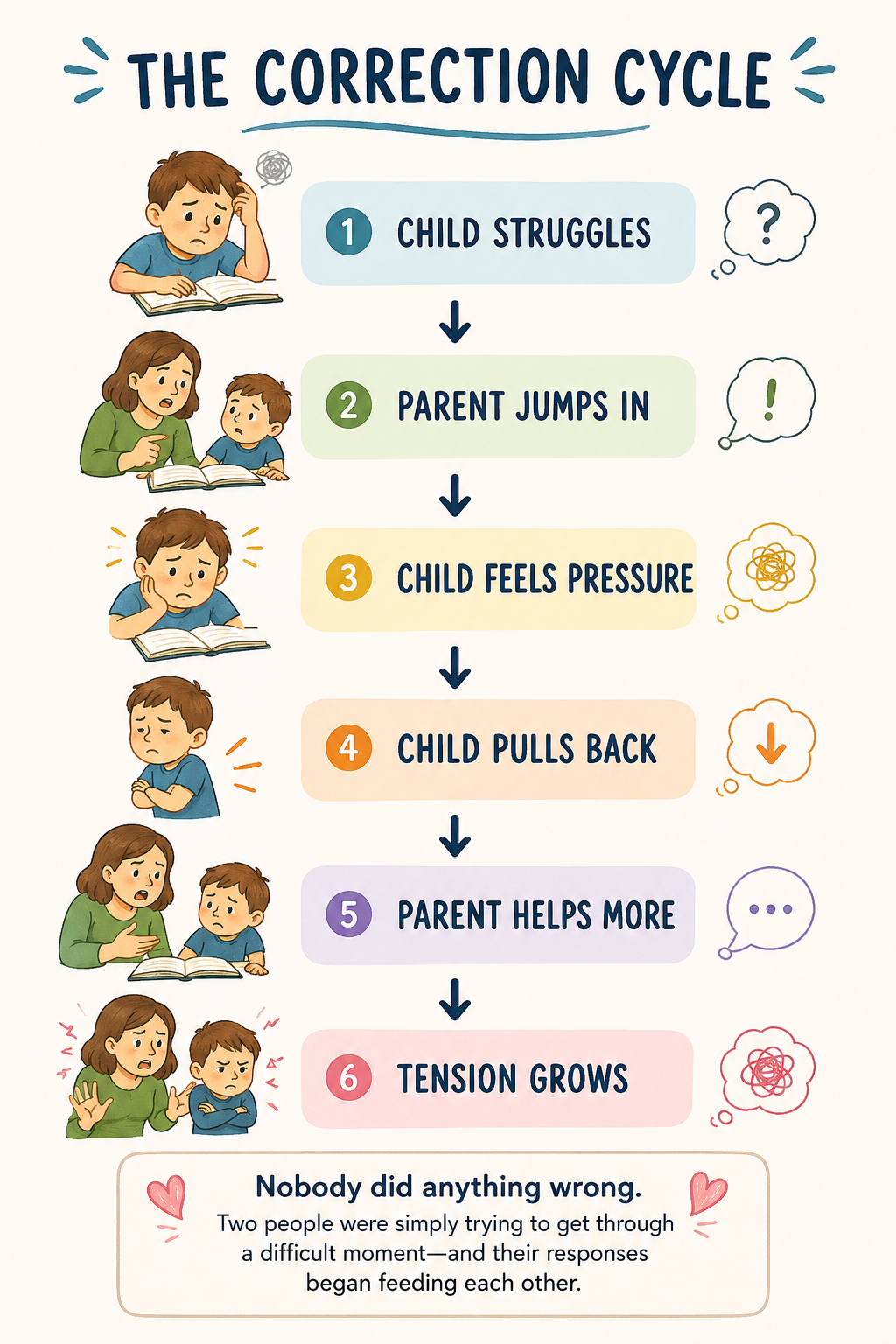
THE GOOD NEWS
A cycle isn’t inevitable.
Once you begin to notice what’s happening between you, you create a moment where something different can happen.
You don’t have to fix the word immediately.
You can notice the moment first.
INTERRUPT THE CYCLE WITH A PAUSE 3.2????
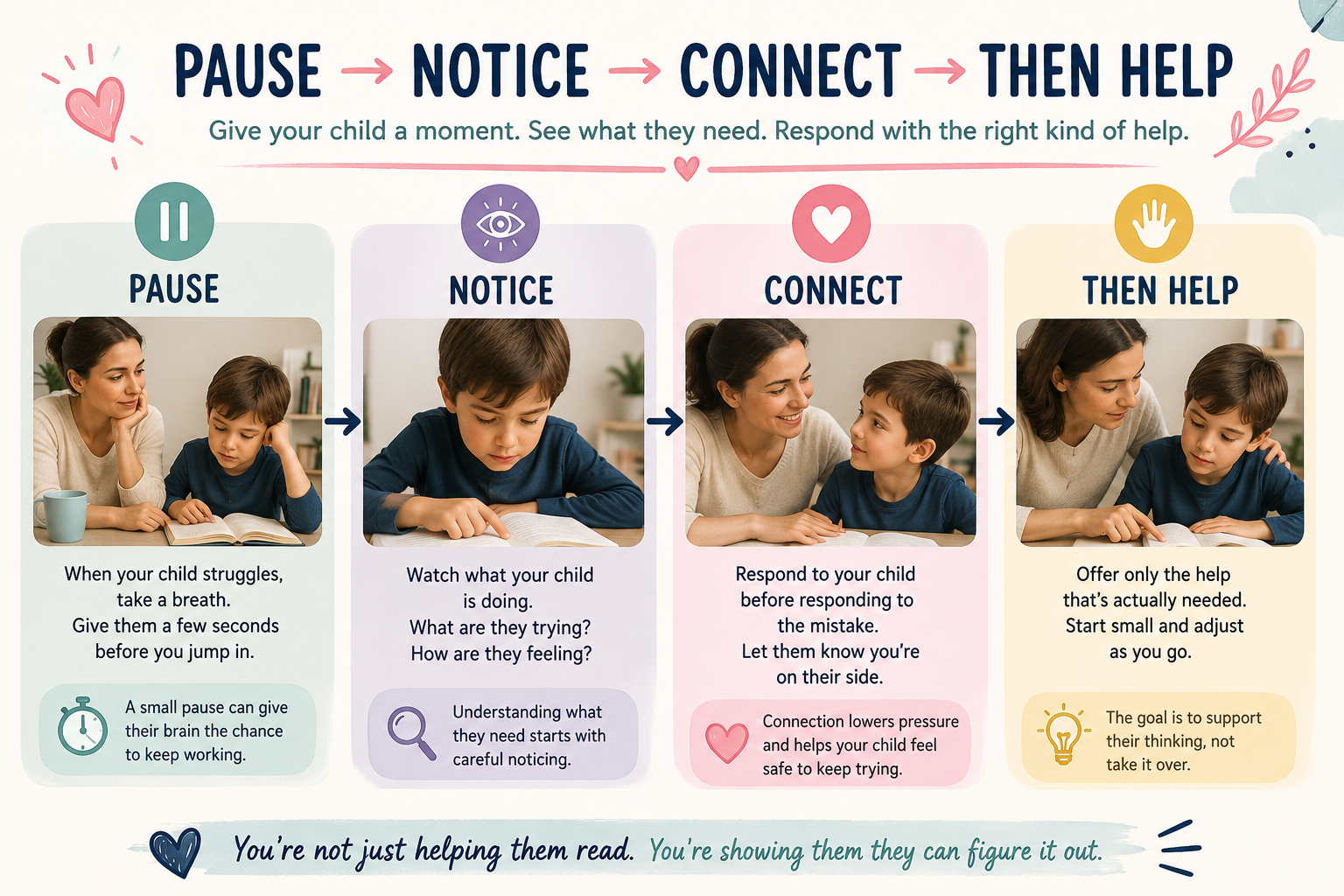
Now give them something extremely simple to do.
Your child struggles.
Don’t immediately fix it.
Instead:
PAUSE
Give them a few seconds.
NOTICE
What are they actually doing?
Are they thinking?
Trying a strategy?
Looking at the word?
Getting frustrated?
Looking at you for help?
CONNECT
Respond to the child before responding to the mistake.
THEN HELP
Give only the help that’s actually needed.
💬 INSTEAD OF THIS → TRY THIS 3.2; 3.3??
Sometimes Connection Means Giving the Word 3.3
If your child has been staring at a word, frustration is rising, and figuring it out is no longer productive:
Give them the word.
Then keep reading.
You haven’t ruined the learning opportunity.
You’ve protected the flow of the story—and possibly the reading experience itself.
There will be other words.
There will be other books.
There will be other opportunities to teach.
🌸 REMEMBER
Not every difficult word needs to become a lesson.
Sometimes the best support is simply:
“That word is enormous. Keep going.”
📌 Try it Together – Private Reflection
Before You move on
Same Help, Different Feeling
📌 Try it Together – Private Reflection
Before You move on
💭 THINK ABOUT IT
When my child struggles with a word, what do I usually do first?
Not: What should I do?
Just: What do I actually do?
Notice it this week.
No fixing required yet.
Situation 1
You mean to encourage.
Your child pauses at a word. Before they have much time to think, you gently say:
“Come on — you know this one.”
Even though you mean to encourage them, what might your child hear?
It could feel that way
Tone, relationship and the moment all matter. Your child may hear encouragement.
But another child — or the same child on another day — may experience the words differently.
That’s worth noticing
The parent means, “I know you can do this.”
But a struggling child may hear, “I should already know this — and I don’t.”
The intention is encouraging; the impact may still feel like pressure.
Maybe — but look a little closer
The parent is actually trying to help. A more likely mismatch is between
“I believe in you” and “I should already know this.”
Situation 2
You mean to give useful guidance.
Your child struggles with a word. You offer one idea, then another:
“Look at the first letter. What sound does it make? Remember what we did yesterday?”
What might repeated help begin to feel like?
That’s the parent’s intention
And sometimes the child may experience it that way.
But when prompts come quickly or pile up,
help can start to feel like a stream of corrections.
Exactly the distinction
The parent is thinking, “I’m giving them tools.”
The child may be experiencing, “Everything I try is wrong.”
Both experiences can exist at the same time.
Probably not the main issue here
Everything the parent is doing suggests that they care deeply.
The potential impact isn’t lack of care — it’s that
so much help can begin to feel like pressure.
Situation 3
The words don’t change — but the moment does.
Earlier in the week, your child happily responded when you said:
“Want to look at the first sound?”
Tonight they’re tired, tense and already frustrated. You use exactly the same words.
What does this tell us?
Not necessarily
A phrase can feel supportive in one moment and frustrating in another.
The words are only part of the interaction.
It’s more nuanced than that
This course isn’t about memorizing perfect phrases.
Context, timing, tone and your child’s response all matter.
That’s the big idea
The same words can feel supportive one day and like pressure the next.
What matters isn’t only what we say — it’s how our child is experiencing the interaction.
The big idea
Help isn’t helpful simply because we intend it to be.
We can stay curious about how our support is landing — without judging ourselves
or trying to find one perfect script.
Key Takeaways
Help is most helpful when it still feels like help.
THINK ABOUT IT
hen my child struggles with a word, what do I usually do first?
Then underneath:
Not: What should I do?
What do I actually do?
Then:
Just notice it this week. No fixing required yet.
UP NEXT — Pause Before You Help
So what can you do in that tiny moment before your correction reflex takes over?
In the next lesson, you’ll practise one surprisingly powerful skill: giving the moment a little more space.