From Chaos to Connection
Lesson 1.4: Partnering With Teachers and Schools

Build bridges between home and school
When home and school work together, children feel supported on every side.
Collaboration amplifies growth — especially when parents and teachers share insights, celebrate progress, and approach challenges as a team.
Key Points:
- Open Communication Channels: Schedule regular check-ins with teachers to share what works at home and learn about classroom strategies you can reinforce. Keep messages brief and positive, focusing on progress and patterns.
- Share Your Child’s Reading Profile: Communicate interests, preferred learning styles, and successful motivation strategies to help teachers personalize instruction.
- Bridge Different Approaches: When school methods differ from your home style, find common ground. Explain both approaches positively to your child to model flexibility and trust in their learning team.
- Advocate with Data & Love: Keep simple records of home reading progress to share during conferences, framing every conversation around supporting your child’s growth — not comparing or correcting.
The Thompson Family & The Conversations That Went Nowhere
Part 1: When Advocacy Feels Like Fighting
Part 1: When Advocacy Feels Like Fighting
Marcus Thompson discovers his son Jayden’s report card shows “Below Grade Level” in reading. Panicked and frustrated, he sends an emotional, accusatory email to the teacher: “Why didn’t you tell me he was so far behind? What are you doing to help him?”
At the meeting, Marcus arrives unprepared, defensive, and emotional. He interrupts, dismisses assessment data he doesn’t understand, and treats the teacher like an adversary. The meeting ends with vague promises like “we’ll keep an eye on him” and “let’s check in later.” Nothing changes for Jayden.
Part 2: Learning to Be a Partner, Not a Fighter
Part 2: Learning to Be a Partner, Not a Fighter
Marcus’s sister (a teacher herself) gives him advice: start documenting what he sees at home, then request a meeting where he comes prepared, asks questions, listens, and works with the teacher.
Marcus keeps a notebook for two weeks, tracking specific observations:
- “Nov 3: Homework took 45 min. Jayden struggled with ‘because’ and ‘friend'”
- “Nov 10: Cried tonight. Said ‘I’m the worst reader in my class.'”
He sends a completely different email: collaborative, respectful, solution-focused. The teacher responds warmly: “I’d be happy to meet. I’m glad we can work together on this.”
Part 3: The Partnership That Changed Everything
Part 3: The Partnership That Changed Everything
Marcus prepares for the meeting: brings his documentation, writes specific questions, practices starting positively. The meeting is completely different.
He opens with gratitude, listens first, shares his observations, and asks clarifying questions. Together, they create an action plan with specific strategies, responsibilities, and follow-up dates. Marcus leaves with clarity and feels like he and Ms. Rodriguez are finally on the same team.
Six weeks later, Jayden is making real progress. Marcus and the teacher have maintained consistent communication through brief, constructive check-ins.
The core message: Effective advocacy isn’t about fighting harder—it’s about communicating smarter, preparing better, and building genuine partnerships with teachers.

🪄 Mini Practice Moment:
Before your next teacher meeting or message, jot down a short "snapshot" of your child's reading life at home:
- Current Interest: What book or topic currently excites them?
- Recent Win: What new skill or effort you've noticed?
- Question for Teacher: One small question you'd love the teacher's insight on.
Email Templates for Parent-Teacher Communication
Template 1: Introduction Email (Beginning of Year)
Subject: Excited to partner with you this year – [Child’s Name]
Dear [Teacher’s Name],
I’m [Parent Name], [Child’s Name]’s parent. I’m excited about this school year and wanted to introduce our family and share a bit about [Child’s Name] as a reader.
What lights them up: [Current interests – e.g., “loves books about space and graphic novels”]
How they learn best: [e.g., “visual learner, benefits from breaking tasks into steps”]
Recent reading growth: [e.g., “started self-correcting more often, building confidence”]
I’d love to know how I can support what you’re working on in the classroom. Are there strategies or routines you’d recommend we practice at home?
Thank you for all you do!
[Your Name]
Template 2: Sharing a Concern
Subject: Quick check-in about [Child’s Name]’s reading
Hi [Teacher’s Name],
I hope this message finds you well! I wanted to reach out about something I’ve noticed at home with [Child’s Name]’s reading.
What I’m noticing: [Specific observation – e.g., “struggles with confidence on longer words, gets frustrated easily”]
What we’ve tried: [e.g., “using the 5-second pause, breaking words into chunks”]
I’m curious if you’re seeing similar patterns at school, and if there are strategies you’re using that I could reinforce at home. I want to make sure we’re working together to support them.
Would you have time for a quick call or meeting in the next couple of weeks?
Thank you!
[Your Name]
Template 3: Sharing a Win
Subject: Celebrating progress with [Child’s Name]!
Hi [Teacher’s Name],
I wanted to share a quick win from home!
[Child’s Name] [specific accomplishment – e.g., “read their first chapter book independently this week” or “self-corrected three times without prompting last night”].
I know you’ve been working on [specific skill] at school, and I can really see it paying off. Thank you for all you’re doing!
[Your Name]
Reading Snapshot
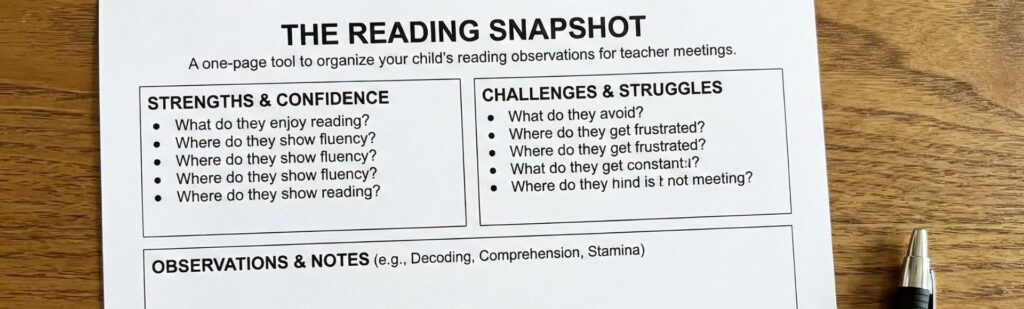
The Reading Snapshot Template
What it is: A quick, one-page tool to organize your observations about your child’s reading before meeting with teachers.
Why it works: Instead of trying to remember everything in the moment or feeling tongue-tied at conferences, you’ll arrive with a clear picture of what’s happening at home. Teachers appreciate when parents come prepared with specific observations—it makes the conversation more productive and actionable.
When to use it:
- Before parent-teacher conferences
- When requesting a meeting about reading concerns
- Before IEP or 504 meetings
- Anytime you want to check in with the teacher about reading progress
How to use it: Take 5-10 minutes to jot down what you’re noticing. You don’t need complete sentences—quick notes work perfectly. The examples provided will help jog your memory if you’re not sure what to write.
The result: You’ll have concrete examples to share, specific questions to ask, and a record of your child’s reading journey over time. This turns vague conversations (“He’s struggling”) into productive partnerships (“Here’s exactly what I’m seeing, and here’s what I need help with”).
When communication is kind and curious, partnership becomes possible.

Finish Course Early?
You have not completed all required lessons and assessments.