Lesson 1.1 – Reframing Reading Struggles into Opportunities

Reframing Reading Struggles into Opportunities
Every reader hits rough spots — even adults
This first lesson sets the emotional foundation for everything else. We’ll reframe reading challenges from setbacks into stepping-stones. You’ll learn how to normalize mistakes, use growth-mindset language, and turn tense moments into opportunities for connection and resilience.
Your goal – to be their calm, curious guide — not a frustrated critic.
Before we dive in, we need to start where all confident reading begins – with how we respond when things feel hard. When reading feels hard, shift how you respond. Learn how to normalize challenges, use growth-mindset language, stay curious instead of critical, and celebrate tiny wins that build lasting confidence.
Every stumbling block is a stepping-stone in disguise. In this first lesson, we’ll gently shift how we think and talk about reading challenges so our children experience them as invitations to grow, not reasons to feel defeated. By the end, you’ll have fresh language, practical strategies, and a heart-centered mindset that turns frustrations into confidence-building moments.

Key Points:
Normalize the Struggle: All readers—grown-ups included—encounter tricky words and moments of confusion. When we treat these bumps as natural, children feel safe to take risks.
Use Growth-Mindset Language: Replace “You got it wrong” with “You’re still figuring it out.” Simple shifts in wording reinforce that ability grows with effort and strategies.
Get Curious, Not Critical: Pause to wonder why a stumble occurred (fatigue? unfamiliar vocabulary?) and brainstorm solutions together, modeling problem-solving rather than blame.
Spotlight Micro-Wins: Celebrate small victories—self-corrections, brave guesses, longer focus—to build momentum and show that progress is happening every day.
Reframing struggles takes conscious practice, but each positive response plants a seed of resilience. Keep these four points handy this week, and notice how your own calm, curious energy invites your child to persevere with joy.

The Martinez Family Story
This story unfolds in three short parts. Open one section at a time.
As you read:
- Put yourself in Sofia’s place.
- Notice your emotional reactions — discomfort, recognition, hope.
- Pay attention to the language shift between Part one and Part two.
After reading all three sections, ask yourself:
What phrases do I sometimes say when my child struggles?
What would it sound like to respond with curiosity instead?
What small change could I try this week?
This story isn’t about perfection. It’s about small shifts that change everything. Click on the different parts below to read the story.
Part 1: Before the Shift
Part 1: Before the Shift
It’s 7:30 PM on a Tuesday. Sofia Martinez calls up the stairs: “Lucas! Reading time!”
Silence.
“Lucas, come on! We do this every night!”
Seven-year-old Lucas drags himself to the couch, arms crossed. Sofia opens the book they started yesterday.
Lucas stumbles on the third word: “The… the… th—”
“Come on, you know this word! We read it yesterday!”
Sofia’s voice has an edge.
Lucas tries again: “The… cat… wa… wal…”
“WALKED. You’ve seen this word a hundred times!” Sofia’s frustration bleeds through every word.
Lucas’s eyes well up. His body goes rigid. “I hate reading.”
Sofia sighs heavily. “If you would just try harder…”
They finish the page in painful silence. Sofia feels like a failure. Lucas feels ashamed. Neither wants to do this again tomorrow.
But they will. Because that’s what they do every night.
Part 2: The Turning Point
Part 2: The Turning Point
The next week, something shifts.
Lucas stumbles on the same word: “walked.”
Sofia feels the familiar frustration rising. But this time, she pauses. She counts to five silently.
When she speaks, her voice is different—curious instead of critical:
“Hmm, that word’s being tricky today. What do you notice about it?”
Lucas looks surprised. Then: “It… it has an ‘ed’ at the end?”
“Yes! You spotted a pattern. That ‘ed’ makes it past tense—it happened before. The cat walked… yesterday! Let’s use that.”
Lucas tries again: “Walked.” Success.
Sofia smiles. “You figured it out by noticing the pattern. That’s what good readers do.”
Something in Lucas’s shoulders relaxes. For the first time in weeks, he doesn’t ask if they’re done yet.

Part 3: Three Weeks Later
Part 3: Three Weeks Later
Reading time still isn’t perfect. But it’s different.
Last night, Lucas got stuck on “bicycle.”
Old Sofia would have said: “Sound it out! You’re not even trying!”
New Sofia said: “That’s a long word. Want to break it into chunks together?”
They figured it out. Together.
This morning, Lucas brought a book to breakfast. “Can we read this one tonight?”
Sofia almost cried.
The difference? Sofia learned that her response to struggle matters more than whether Lucas gets every word right.
The transformation: From critic to curious guide. From shame to safety. From battles to bridges.
That’s what this lesson will teach you to do.
What makes the difference isn't whether your child struggles; it's how you respond.
The Power of Your Response
Think of reading a medical form or a dense work memo. That pause, re-read, or sigh you experience? Totally normal.
When your child sees you stumble on a word and calmly say, “Hmm, that word surprised me! Let’s look at it again,” you’re not teaching decoding — you’re teaching emotional regulation.
Your calm, curious response becomes the safe space your child needs to take risks.
Ask yourself:
When your child gets stuck on a word, what’s your first reaction?
What does your face do? Your shoulders?
What words come out of your mouth?
What This Can Look Like
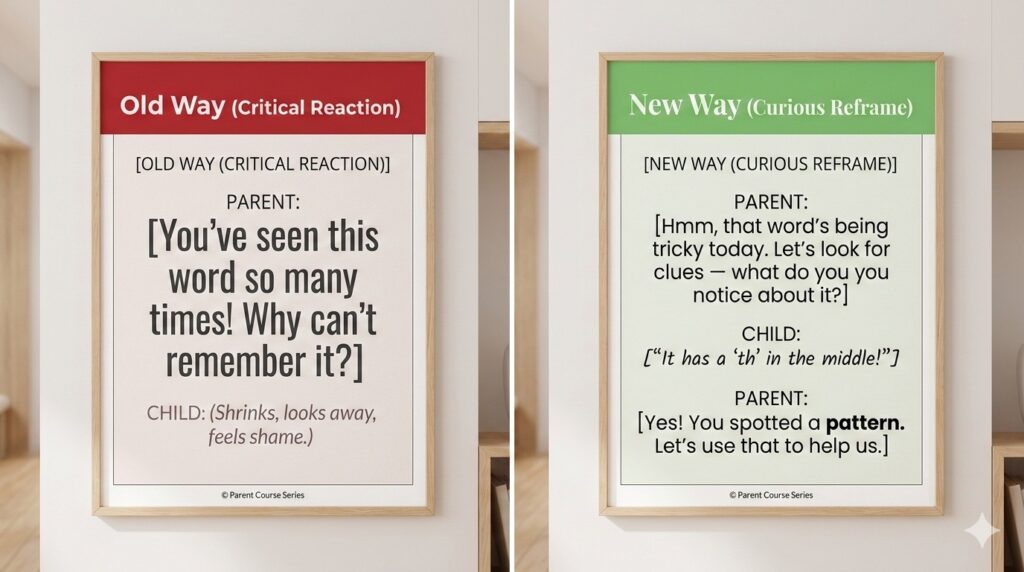
Scenario 1: The Repeated Word
Before (Critical Reaction):
Child struggles with “said” for the 10th time
Parent (frustrated): “You’ve seen this word SO many times! Why can’t you remember it?”
Child: Shrinks, looks away, feels shame
Internal message: “I’m failing. I should remember this. Something’s wrong with me.”
After (Curious Reframe):
Child struggles with “said” for the 10th time
Parent (genuinely curious): “Hmm, that word is being really tricky for you. I wonder why? Let’s think… You know how to read ‘sad’—how is this one different?”
Child: “It has that weird ‘ai’ sound!”
Parent: “YES! That’s exactly the tricky part. ‘Said’ is one of those rule-breaker words. Want to make up a silly sentence to remember it?”
Internal message: “Struggle is normal. I can figure out WHY something’s hard. My mom is on my team.”
Scenario 2: The Guess-and-Check
Before (Corrective Reaction): Child reads “The horse ran fast” as “The house ran fast”
Parent (correcting immediately): “No! That says ‘horse,’ not ‘house.’ Look at the word!”
Child: Feels embarrassed, rushes through rest of page
Internal message: “I make too many mistakes. I need to read faster so Mom doesn’t catch more errors.”
After (Curious Reframe): Child reads “The horse ran fast” as “The house ran fast”
Parent (pausing, curious): “Hmm, I heard you say ‘house.’ Does it make sense for a house to run?”
Child: “No… OH! Horse! It’s horse!”
Parent: “You caught your own mistake! That’s what smart readers do—they notice when something doesn’t make sense and they fix it themselves.”
Internal message: “I can catch my own mistakes. Mistakes give me information. Self-correcting is a skill.”
Scenario 3: The Shutdown
Before (Frustrated Reaction):
Child gets stuck on multiple words and says “I can’t do this”
Parent (exasperated): “Yes, you can! You’re just not trying hard enough. Focus!”
Child: Shuts down completely, won’t read anymore
Internal message: “I’m not trying hard enough. I’m disappointing my parent. Reading is stressful.”
After (Validating & Strategic): Child gets stuck on multiple words and says “I can’t do this”
Parent (calm, validating):
“You know what? This book might be a little too tricky right now, and that’s totally okay. Even I don’t read books that are too hard for me! Let’s pick something easier so we can enjoy the story. Want to choose?”
Child: Relaxes, picks easier book, reads successfully
Internal message: “Sometimes books are hard. That’s not my fault. Choosing the right book is smart. Reading can still be fun.”
Key Strategies: Four Shifts to Build Confidence

Please click on the strategies below to learn more about how to shift and build confidence.
Normalize the Struggle
Strategy #1: Normalize the Struggle
The Principle: All readers struggle—even adults. When you treat bumps as natural, children feel safe to take risks.
What This Sounds Like:
- “Even grown-ups get stuck on words sometimes. It’s totally normal.”
- “You know what? I had to read that sentence twice too. Tricky one!”
- “Reading has easy parts and hard parts. Both are okay.”
Why It Works: Removes shame. Reframes struggle from “I’m bad at this” to “This is how learning works.”
The Martinez Example: When Lucas stumbled for the third time on “through,” Sofia said: “You know what? That word tricks EVERYONE. It doesn’t follow the rules. Even I have to think about it.” Lucas visibly relaxed.
Use Growth-Mindset Language
Strategy #2: Use Growth-Mindset Language
The Principle: Your words teach your child whether mistakes are shameful or whether they’re information.
The Language Shift Chart:
❌ Fixed Mindset (Avoid) | ✅ Growth Mindset (Use) |
“You should know this by now.” | “You’re still figuring it out—that’s how learning works.” |
“We’ve done this a hundred times.” | “This is a tricky one! Let’s try it a new way together.” |
“Stop guessing!” | “Let’s slow down and look for clues in the word.” |
“You’re not paying attention.” | “It looks like your brain needs a quick break—let’s wiggle.” |
“That was wrong.” | “Good try—you found part of it! Let’s look at the next sound.” |
“Why can’t you remember this?” | “Let’s find a way to help this word stick.” |
Quick Tip: Replace “Why” questions with “What” or “How” questions:
- ❌ “Why did you say that?”
- ✅ “What clue could we use here?”
Get Curious, Not Critical
Strategy #3: Get Curious, Not Critical
The Principle: Curiosity models problem-solving and shows that mistakes are information, not failures.
What Curiosity Sounds Like:
- “Hmm, I notice you keep saying ‘house’ for ‘horse.’ I wonder why? Oh! They both start with ‘h.’ Let’s look at the end of the word.”
- “That’s interesting—you read ‘was’ instead of ‘saw.’ Those words do look similar! What’s different about them?”
- “I see you skipped that word. What made it tricky?”
The Internal Shift:
- OLD RESPONSE: Frustration → “They’re not trying hard enough”
- NEW RESPONSE: Curiosity → “What’s challenging about this? What can I learn?”
The Martinez Example: Lucas read “The boy ran to the store” as “The boy run to the store.”
Old Sofia would have said: “RAN. Not run. You need to pay attention to the ending!”
New Sofia said: “Interesting! You said ‘run’ but the word is ‘ran.’ What do you notice about the ending?” Lucas spotted the difference himself.
Spotlight “Micro-Wins”
Strategy #4: Spotlight “Micro-Wins”
The Principle: Celebrate effort, noticing, and strategies—not just correct answers.
What to Celebrate:
- Effort: “I loved how you stuck with that word.”
- Self-correction: “You caught your own mistake—that’s what great readers do!”
- Strategy use: “You used the picture to help—what a smart strategy!”
- Persistence: “That was hard, and you didn’t give up.”
- Pattern recognition: “You noticed those two words rhyme! Good eye.”
Why Micro-Wins Matter:
- Build momentum faster than waiting for big milestones
- Show that the PROCESS is what matters
- Create dozens of positive moments per reading session
- Shift focus from perfect performance to skillful practice
What NOT to Do:
- Generic praise: “Good job!” (meaningless without specifics)
- Dishonest praise: Praising when they actually didn’t try
- Outcome-only praise: “You got it right!” (ignores the learning)

Language That Transforms
Small shifts in your words create massive shifts in your child’s confidence. Keep this chart handy during reading time:
Old Phrase (Fixed Mindset) |
“You should know this by now.” |
“We’ve done this a hundred times.” |
“Stop guessing!” |
“You’re not paying attention.” |
“That was wrong.” |
New Reframe (Growth Mindset) |
“You’re still figuring it out — that’s how learning works.” |
“This is a tricky one! Let’s try it a new way together.” |
“Let’s slow down and look for clues in the word.” |
“It looks like your brain needs a quick break — let’s wiggle.” |
“Good try — you found part of it! Let’s look at the next sound.” |
Tip: When your child struggles, swap “Why” questions for “What” or “How” questions:
“What clue could we use?” instead of “Why did you say that?”
Try This This Week
Please click on the activities below to decide which one you would like to try first!
Activity 1: The “5-Second Pause”
Activity #1: The 5-Second Pause
What It Is:
When your child gets stuck, silently count to five before you speak.
Why It Works:
- Gives your child’s brain time to self-correct
- Prevents you from jumping in too quickly
- Creates space for independent problem-solving
- Reduces your own anxiety response
How to Do It:
- Child stumbles or pauses on a word
- You silently count: 1… 2… 3… 4… 5…
- THEN respond (if they still need help)
What Often Happens:
- Child self-corrects during the pause (30-40% of the time!)
- Child tries a new strategy
- Child looks to you for help calmly (not anxiously)
Track It:
Use the Practice Log (download below) to record:
- How many times did you pause this week?
- How many times did your child self-correct during the pause?
- What did you notice about your own stress level?
The Martinez Example:
Lucas paused on “jumping.”
Old Sofia would have immediately said: “JUM-PING. Sound it out!”
New Sofia counted to five.
At “4,” Lucas said: “Jump… ing. Jumping!” He beamed.
Sofia realized: He didn’t need her rescue. He needed her patience.
Activity 2: The “Process-Only Praise” Challenge
Activity #2: The "Process-Only Praise" Challenge
What It Is:
For one read-aloud this week, you’re not allowed to say “Good job!” or “You’re smart.” Only process praise.
Process Praise Starters:
- “I saw you…”
- “I loved how you…”
- “You used a great strategy when you…”
- “I noticed you…”
- “The way you figured that out was…”
Examples:
❌ “Good job!” ✅ “I loved how you sounded out that tricky word piece by piece!”
❌ “You’re so smart!” ✅ “You used the picture to help you figure out the word—that’s what strong readers do!”
❌ “Perfect!” ✅ “You caught your own mistake and fixed it. That’s impressive!”
Why This Is Hard:
“Good job” is a habit. This challenge breaks that habit and replaces it with meaningful feedback.
Reflection Question:
Which process praise phrase felt most natural to you? Which felt awkward? Why?
Activity 3: The “Curious Question”
Activity #3: The "Curious Question" Practice
What It Is:
When your child is stuck, respond with ONE curious question (not a correction).
Your Curious Question Menu:
- “Hmm, what do you notice about that word?”
- “What could we try here?”
- “What clues can you find?”
- “What part do you know?”
- “Does this word look like any other words you know?”
How to Use It:
- Child gets stuck
- Pause (see Activity #1!)
- Ask ONE curious question
- Wait for their response
- Follow their thinking
Why ONE Question:
- Multiple questions feel like a quiz
- One question feels like genuine curiosity
- Gives child space to think
- Models problem-solving mindset
Practice:
Try this at least 3 times this week. Notice how your child responds.
The Martinez Example: Lucas struggled with “butterfly.”
Sofia asked: “What part of this word do you know?”
Lucas: “Butter!”
Sofia: “Yes! And the second part?”
Lucas: “Fly! Butterfly!”
Sofia’s curiosity helped Lucas discover he already knew both parts.

Common Pitfalls to Avoid
Please click on each pitfall below to learn more.
Pitfall #1: The “Through-Gritted-Teeth” Reframe
Pitfall #1: The "Through-Gritted-Teeth" Reframe
What It Looks Like:
Saying the right words (“That’s okay, you’re still learning…”) but with:
- A sigh
- Tense body language
- An eye roll
- A “hurry up” tone
Why It Backfires:
Your tone and body language speak louder than your words. Children read your emotional state, not just your script.
The Fix:
- Breathe FIRST (literally take a deep breath before speaking)
- Check your body: Are your shoulders tense? Soften them.
- Check your face: Are you frowning? Relax your expression.
- If you can’t get to genuine calm, say: “I need a quick break. Let’s come back to this in 2 minutes.”
Honest Truth:
Better to take a break than to fake calm poorly.
Pitfall #3: Insincere Praise
Pitfall #2: Insincere or Excessive Praise
What It Looks Like:
- Praising every tiny thing: “Good job breathing!” “Great job sitting!” “Wonderful page turn!”
- Praising when child clearly didn’t try
- Generic praise with no specifics
Why It Backfires:
- Dilutes meaning (if everything is “good job,” nothing is special)
- Feels fake to kids (they know when they didn’t actually do something praiseworthy)
- Creates praise dependency
- Loses your credibility
The Fix:
- Keep praise genuine and specific
- Praise effort and strategy, not just outcomes
- Only praise what’s actually praiseworthy
- Silence is okay too—not every moment needs commentary
Pitfall #3: Accusatory “Why” Questions
Pitfall #3: Accusatory "Why" Questions
What It Looks Like:
- “Why did you say that?”
- “Why can’t you remember this?”
- “Why aren’t you trying?”
Why It Backfires:
“Why” questions feel judgmental. They put child on the defensive.
They imply:
“You should know better.”
The Fix:
Replace with “What” or “How”:
❌ “Why did you say that?” → ✅ “What made you think of that word?”
❌ “Why can’t you remember this?” → ✅ “What could help this word stick?”
❌ “Why aren’t you trying?” → ✅ “What’s making this feel hard right now?”
Pitfall #4: Comparing to Other Kids
Pitfall #4: Comparing to Other Kids
What It Looks Like:
- “Your sister could read this when she was your age.”
- “Other kids in your class don’t struggle with this.”
- “Why can’t you be more like [friend’s name]?”
Why It Backfires:
- Creates shame and resentment
- Damages sibling relationships
- Makes child feel fundamentally deficient
- Destroys motivation
The Fix:
- Compare child only to themselves: “Last week this was hard. Now you’re getting it!”
- Celebrate individual progress
- NEVER mention other children’s reading abilities
Remember:
Every child’s reading journey is unique. Comparison steals joy.
Pitfall #5: Inconsistency
Pitfall #5: Inconsistency
What It Looks Like:
Monday: Patient and curious
Tuesday: Frustrated and critical
Wednesday: Back to patient
Thursday: child doesn’t know which parent they’ll get
Why It Backfires:
- Inconsistency creates anxiety
- Child can’t predict safety
- Mixed messages confuse child about expectations
The Fix:
- You won’t be perfect every day (and that’s okay!)
- When you slip into old patterns, acknowledge it: “Sorry, I got frustrated. Let me try that again.”
- Aim for progress, not perfection
- Apologize when you mess up—it models accountability
After practicing this week’s activities, reflect on these questions:
About the 5-Second Pause:
- When did you try the pause this week? What happened?
- Did your child self-correct? How often?
- What did you notice about your own stress level when you paused?
- Was waiting harder than you expected? Why?
About Process Praise:
5. Which process praise phrase felt most natural to you?
6. Which felt awkward or forced?
7. How did your child respond to specific praise vs. generic praise?
8. What did you learn about what your child actually values?
About Old Habits:
9. What was the hardest old habit to break? (Critical tone? Jumping in too fast? Generic praise?)
10. When did you catch yourself slipping back into old patterns?
11. What triggers your frustrated response? (Time pressure? Tiredness? Specific words?)
12. What helped you get back on track?
About Impact:
13. What small shift made the biggest difference this week?
14. Did you notice any changes in your child’s attitude toward reading time?
15. Did your child take any risks they wouldn’t have taken before?
16. What surprised you most?
Moving Forward:
17. What’s one thing you’ll definitely keep doing?
18. What’s one thing you’ll work on next week?
19. What support do you need to maintain these changes?
The Neuroscience of Safety
When children feel criticized or judged:
- Amygdala activates (fear/threat response)
- Prefrontal cortex goes offline (learning center)
- Body enters stress mode (fight/flight/freeze)
- Working memory decreases (can’t access what they know)
- Result: Child literally can’t learn effectively
When children feel safe and supported:
- Prefrontal cortex stays active (learning center engaged)
- Working memory is accessible (can use strategies)
- Risk-taking increases (willing to try new words)
- Persistence improves (doesn’t give up as quickly)
- Result: Learning is possible
The Power of Growth Mindset
Dr. Carol Dweck’s research shows:
- Children who believe intelligence is FIXED give up faster when challenged
- Children who believe intelligence is GROWABLE persist through challenges
- Your language shapes which belief your child develops
When you say:
“You’re so smart!” Child hears: “I’m smart when I get things right. If I struggle, I’m not smart anymore.”
When you say:
“I love how you figured that out!” Child hears: “Figuring things out is what matters. Struggle is part of the process.”
The difference:
First creates fragility. Second creates resilience.
Why Micro-Wins Matter
Traditional motivation theory says: Set big goals, work toward them, celebrate when you reach them.
Problem:
Reading progress is slow. Big goals are far away. Child gets discouraged.
Solution:
Micro-wins create dozens of success moments per reading session.
Research shows:
Frequent small wins:
- Release dopamine (motivation chemical)
- Build confidence incrementally
- Create positive associations with reading
- Increase persistence
Example: Instead of waiting to celebrate finishing a book (1 win in 2 weeks), celebrate:
- Sounding out a tough word (daily win)
- Self-correcting a mistake (happens multiple times per session)
- Using a picture clue (can happen every page)
- Asking a question about the story (shows engagement)
Result: Child experiences reading as a series of successes, not struggles.
Going Deeper: Advanced Concepts
The Co-Regulation Principle
The Concept: Children can’t regulate their own emotions until they experience being regulated by a calm adult.
What This Means:
- Your child’s frustration isn’t the problem—it’s developmentally normal
- Your calm in the face of their frustration teaches them how to become calm
- You can’t expect your child to “calm down” if you’re not calm yourself
- Co-regulation comes before self-regulation
In Practice: When your child is frustrated during reading:
- YOU regulate yourself first (breathe, soften body, calm voice)
- Acknowledge their feeling: “This is frustrating”
- Stay present and calm while they experience the frustration
- Model problem-solving once they’re calmer
Over time: Your consistent calm becomes their internal calm.
The Attribution Theory
The Concept: How you attribute success or struggle shapes your child’s beliefs about their abilities.
Two Types of Attribution:
Fixed Attribution (Avoid):
- Attributes success to innate traits: “You’re so smart!”
- Attributes failure to lack of ability: “Reading is just hard for you”
- Result: Child develops fixed mindset, gives up when challenged
Growth Attribution (Use):
- Attributes success to effort/strategy: “Your strategy worked!”
- Attributes struggle to normal learning process: “Your brain is building new pathways”
- Result: Child develops growth mindset, persists through challenges
The Key: What you say about WHY something happened shapes what your child believes is possible.
The Self-Fulfilling Prophecy
The Concept: Children become what we believe about them.
How It Works:
- You hold a belief about your child (“She’s not a natural reader”)
- Your behavior reflects that belief (lower expectations, more help, less challenge)
- Your child responds to your behavior (matches your low expectations)
- Your belief is “confirmed” (but YOU created the outcome!)
The Flip Side:
- You hold a belief about your child (“She’s building her reading skills”)
- Your behavior reflects that belief (appropriate challenge, growth language, patience)
- Your child responds to your behavior (rises to expectations, builds confidence)
- Your belief is confirmed (child grows into capable reader)
The Power: Your beliefs about your child’s capacity directly shape their capacity.
The Practice: Monitor your self-talk about your child. Are you speaking (even internally) in ways that assume growth is possible?